Showing posts with label Army. Show all posts

Saturday, February 18, 2012

Hoorah!

It was a beautiful morning for running. Temperate, dry and still.

I ran 4.1 miles at a slow pace, clocking the first mile at 10:45, then circling back to my driveway at the midway point to drink the water I had left there while I temporarily suspended my clock at 22 minutes. Glancing past my back yard as I drank, I saw two soldiers in camouflage run by on the W&OD trail behind my house carrying bulging backpacks, leaning forward and moving at a slow, steady trot.

As I continued my run, I encountered them a few minutes later returning on the W&OD Trail, moving ever forward in a brisk shuffle, running quietly in their soft-soled combat boots. I fell in beside these two lean young men.

"Who are you with?" I asked. The nearest one looked over and politely said, "112th Regiment." The second soldier stared straight ahead, sweat pouring down his face.

"What are you training for?" I asked. "The Ranger Competition in the spring, sir," he answered. "We go 40 miles with 60 pounds that first day." A runner passed us going the other way and called to these two men, "You guys are terrific! Thank you!"

"How far are you going today?" I asked. "Fifteen miles with 45 pounds. We just reached the turnaround back there," the one next to me said.

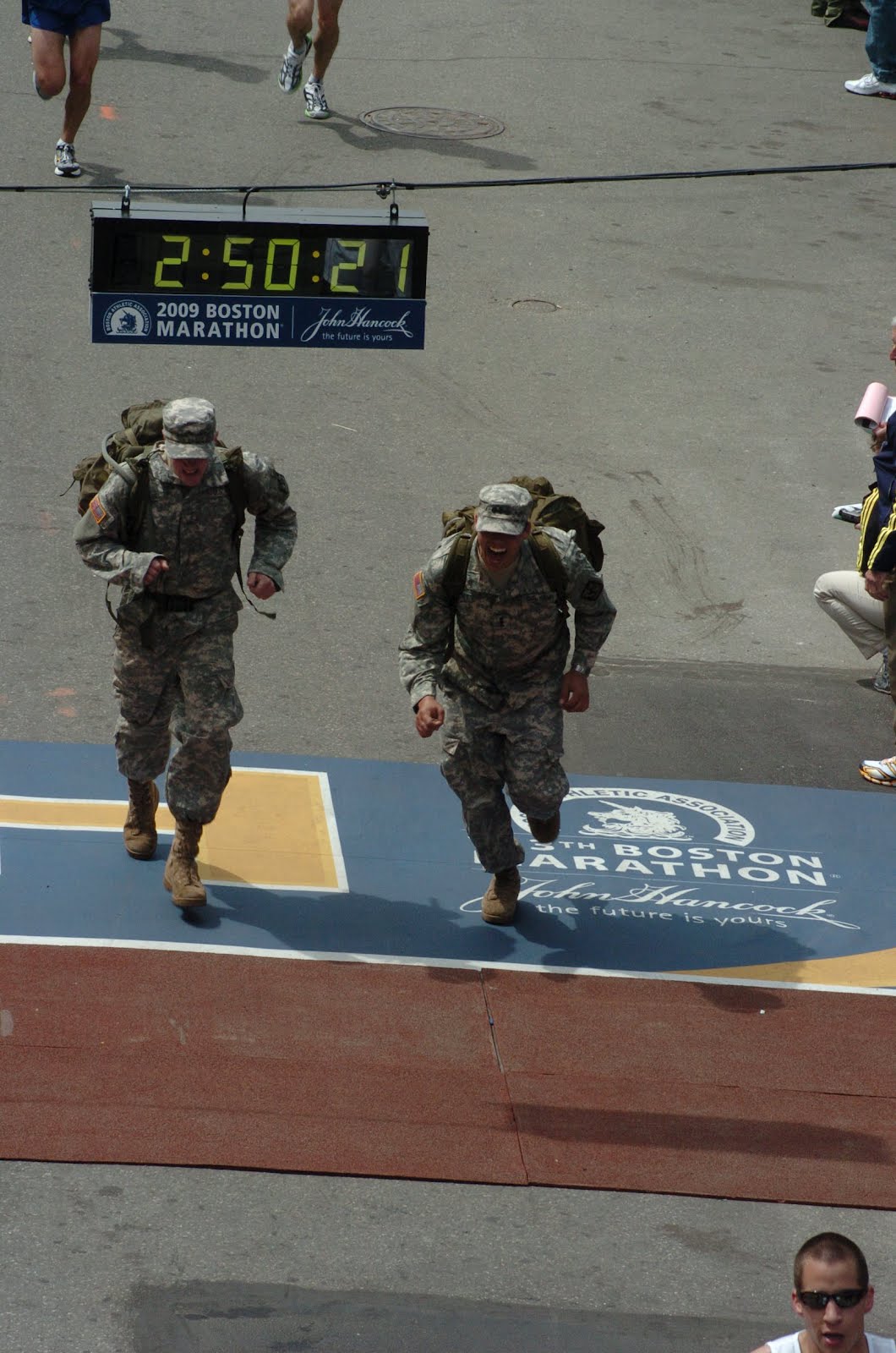
I was running on the uneven dirt shoulder of the blacktop trail, wobbling slightly due to the undulating surface. The two soldiers running abreast moved over slightly and the closest one said, "You can run up here, sir." (Left: I ran briefly this morning with heavily-laden soldiers like these two pictured finishing a marathon. They always run together in support of each other.)

Instead, I wished them well, bid them adieu and turned off the trail to finish my run, energized by the awesomeness of their presence. I finished my 4.1 miles in 39:21, with a substantial negative split after seeing those guys.

Sunday, October 4, 2009

Army

Today I was the 1:30:00 (9:00) pace leader at the Army Ten-Miler. It's the first year the race has had pacers, so we're all under scrutiny.

I have a bag of frozen peas on my left ankle as I write this. It's been sore for weeks and although it doesn't restrict me from running, it prevents me from walking without a limp for days afterwards. My farewell-to-coaching run last Saturday was the only run I have done in two weeks. I figured I had one more ten-mile run in me so I wanted to make it count, on race day.

Pacing is hard. Rather, it's stressful, especially in a short race like a ten-miler where there isn't much time to make up for a bad mile or two.

A lot of people were looking to me to bring them to their goal of breaking 1:30. Although they gathered around me and my 1:30:00 sign at the start, on the course I often felt like I was running alone in the crowded race, with a sign thrust into the air.

There were runners out there watching me though. Runners I started with dropped away and caught back up. Other determined runners saw my sign and struggled up to me and passed me by in the last two miles. Some runners hung with me on the edges, keeping my sign in sight, acting like lurkers in an Internet chat room.

The first mile, about which I was the most worried because of the crush of people, went by in 9:15. Then we banked a little time in the early miles and got slightly ahead of our goal time by the fifth mile, passing it at about 44:10 instead of 45 flat. I knew that the long, visually daunting uphill expanse of the 14th Street Bridge was coming in the ninth mile, followed by the run onto slightly higher ground to the west in Virginia during the last mile.

Around the Capitol we had some personally satisfying 9:03 or 9:04 miles and then incredibly, as we approached the bridge, my system started going out of whack. Not enough food that morning, I think. With my head down (always a bad sign for me in a race) and worse, my heart racing, my body ignoring my yoga deep cleansing breaths, I desperately tried sucking down a GU to get back a feeling of control. Ah, within a few minutes I was back on a steady nine-minute rhythm. Sustenance, it really works.

I finished in 1:29:44 (8:58). Several people came up to me afterwards to say thanks. One went away ecstatic with my sweaty Army 25th Running wristband, and another thought me giving him the 1:30:00 sign was just the cat's meow. "My wife will just love this," he said.

I just smiled, having just finished a duty which turned out to be devilishly difficult.

Saturday, October 3, 2009

Synthesis

As I went by the Mall's World War II Memorial alongside L on my last training run as a coach for my club, I told L that carved into the wall over by the Atlantic column were two battles that the father of a close friend had fought at, the Bulge and the Rhineland. This old Patton warrior had passed on mere weeks ago, another American hero gone away. L, being a Navy veteran, was non-responsive in talk about a soldier.

Then I said that carved into the wall over by the Pacific column were two battles that my father had fought at, Peleliu and Okinawa. L suddenly became animated.

"Really?" he said, with respect in his voice. "My father was a Marine also, and was at Guam and elsewhere and fought at Iwo Jima."

"Really?" I said with respect in my voice. "Me and my brother, who was a combat Marine in Beirut when they blew up the barracks, had an argument once. I said Peleliu was the worst combat in World War II, perhaps in history, since the First Division had to dig entrenched Japanese soldiers out of fortified caves blasted into mutually-supporting steep coral ridges in 112 degree heat with no cover. But he said that Iwo was even tougher, and I had to admit that it probably was."

L is black. In World War II black Marines, who received the same training as white Marines, were kept in segregated outfits and used as supply service troops given the dangerous task of unloading ordnance and other supplies on the beaches while their white brethren fought on the front lines a few miles away. Such was the racism of America in the forties.

At a few desperate, terrible battles in the Pacific, including Peleliu and Iwo Jima, these black troops were called up into the front lines as combat replacements because the fighting was so horrific that there were no other troops available to restore the decimated units to a semblance of combat effectiveness. These Americans, who were fighting two enemies at once, the common enemy and society's prejudice, proved themselves to be worthy of the hero's mantle that cloaked all combat Marines in the Pacific.

L told me that his father is 93, well and living nearby in Maryland. He sees him daily. I asked L to pass my respects on to his father, and tell him that there are young men in our society who read books and know the terrific sacrifices that he and his friends went through. I lied about the young man part. L said that he would pass on my sentiments to his father, who would appreciate hearing them.

With our conversation finally charged, as we ran by the Pentagon near the end of our sojourn, L told me where he was on 9/11/01. He worked in the Pentagon then and lost friends there, but that morning he was on a detail at Bolling Air Force Base. He was out for a run when suddenly security at the base came alive and emergency vehicles started going everywhere. He went into the post and found out we were under attack. He said he wished then that he was at sea in a battle group, because they all would have gone to battle stations instantly and been ready to defend themselves within moments. On the base, however, there was no defense, only chaos. They could only stand by and wait to see what would materialize. It was awful, he said, we were totally unprepared for what hit us that day.

Our interesting conversation at an end, we ran up to our end point, Gotta Run, and the end of both the run and my coaching career. We had gone 8.6 miles in 1:21:59, a 9:32 pace. Mark my word, L is gonna rock his hoped-for 9:30s tomorrow at Army.

Friday, October 2, 2009

Coaching on the Waterfront

I was running with L halfway through my final training run as a coach for my club, in the last long run before the target race, the Army Ten-Miler. Running down the Georgetown Waterfront four miles into the run, we were behind three other Program runners who had formerly been trailing us, thanks to an impromptu stop I had made. The five of us were leading the main body of runners, who were half a mile back with the other Program coaches.

Passing runners in a race, I explained to L, was all about attitude. You have to put them away so they don't hang around.

(Left: The Program runners who ran on Sundays out of Fleet Feet in the District. In the middle, I'm the old-timer in white tank top on the left, Bad John Braden, a terrific coach, is the one on the right.) We came up on the first runner and I told L to follow me. We surged past her in a sustained burst and didn't settle back into our natural pace until we were 10 yards in front. The other two runners were a little ways ahead and when we caught them, we took them the same way, putting distance on them immediately while we passed them.

"See?" I said. "That way in a race, they have to work to get back up to you, and they might expend all their remaining energy or just get discouraged. If you merely cut in front of them, they will hang around behind you and let your energy work for them, drawing them forward. They will pass you back at any time."

We came upon another runner, wearing headphones so I knew she wasn't part of the Program. We smoothly moved around her but she sped up as we went by and we didn't establish any separation. Some runners don't like to be passed and this was definitely such a runner. She started driving us from behind.

She hung with us, pushing us forward into an uncomfortable speed as we labored to stay ahead of her. After a few hundred meters with her on our heels, she suddenly went on by us and we let her go. (Right: Program runners stream down the Georgetown Waterfront this summer led by Bart Yasso, in red.)

"See what I mean?" I said to L. "We didn’t put her away and she passed us back."

We emerged from the waterfront and ran down Rock Creek Park past the Kennedy Center. I could feel the tiredness starting to emanate from L and I slowed down, hopefully imperceptibly, to accommodate his diminishing energy. We did a 9:40 mile, and then fell into the ten-minute-per-mile range as we passed by Lincoln. We were in the homestretch of our run, running down the Mall to round the World War II Memorial before heading for the Memorial Bridge and home, two miles further on.

Passing by World War II, I found the key to unlock L and get him to open up a little, conversationally. All people have interesting tales, sometimes you have to draw them out.

Tuesday, September 29, 2009

Just Me 'n L.

Last Saturday as we left Gotta Run on the training group run after I announced my retirement from coaching for the club, my Garmin as usual was slow to pick up any satellite signals. (Look in the sky, Dummy.) It asked me if I had moved 500 miles since the last reading. I snorted disgustedly and just started running, because I don’t know which of its four button and two bars to push to answer in the negative.

A quarter of a mile into the run we entered the long pedestrian tunnel running under an elevated eight-lane interstate highway that debouches into the South Pentagon parking lot. Charmin picked up the signal while inside that concrete tube. There must be powerful satellite signal boosters around the Pentagon.

I was following H and another woman, running alongside L while a third woman followed us close behind. We were the front running group, swiftly separating ourselves from the main body. With our two fast coaches absent, I pulled front running duty last week. I thought I could probably handle it, having run 1:14:34 (7:27) in my last ATM in 2006. (Right: Program Director Emily leads a discussion in front of a rapt audience. A Certified Outdoor Fitness Instructor in addition to being a certified running coach, this dedicated volunteer devoted half a year to designing, implementing and running an outstanding Program for my club, which also brought the club about $12,000 in revenue. She found the contract for us to be the exclusive training partner for the Army Ten-Miler Race and brought it to us. It would be a no-brainer for my club board to wholeheartedly support Emily's appointment to direct almost any club training program.)

The first mile was in the 10:30 range as we ran by the Pentagon and headed to the river bank along the Potomac. L kept right beside me every step. He had come the furthest in the Program. He used to run mid-pack but lately, although he never pushed the pace, he was always up front.

The two of us forged ahead of H and her companion as I slowly stepped on the gas to drag everyone along in my wake.

L told me that his goal for Army was 1:35 (9:30). He said he’d only done one other race, a 10K in June in 1:03 (10:10). He was running much better than that now and I told him he had an excellent chance of meeting his goal.

The three women behind us remained in sight but started to fall away. No one else was in view but I knew that by design, there were two coaches back there mid-pack with the main group, with yet two more further back acting as sweepers. My task was to lead the strong group out. (Left: Heading out past the Pentagon. This is the corner that was struck on 9/11/01.)

For the first time in sixteen weeks I was out in front and free. Being the Site Director, usually I rove and I always wind up running or walking back with a runner experiencing a problem that day.

We pushed a 9:20 second mile and L didn't get nervous when I announced it. We burned the third mile in 8:48 mile and he didn’t blanch then either.

As we approached the hill on the Mount Vernon Trail which surmounts the bluff leading up to Key Bridge, I explained my theory of hill running to L. Whenever I encounter a hill on a run I attack it in order to derive the maximum benefit from the expected or unexpected occurrence of a hill during a run. A hill is a place where you can take down a faster runner in a race, if you practice it.

L was game and we both labored up the sharp hill, a circular switchback concrete ramp that passes over the GW Parkway and goes up the bridge. We didn't exactly sprint up it but our effort was sharply elevated. We were both winded by the time we gained the bridge. We recovered our breath as we ran into Georgetown across the level expanse of Key Bridge as far below us the dancing azure water of the Potomac sparkled in the bright sunlight.

I coaxed some information out of the naturally taciturn L. A retired Navy officer who now works for a private contractor on a satellite integration system for battle groups, he has never been married. Stationed overseas most of his Navy career, he spent considerable time in Italy, Germany, Japan and the Mid-East, with Rome being his favorite post. He spoke some Italian and German. I love coaching small groups because it enables me to run alongside different people every week and chat with them. Everybody has an interesting story.

Once over the bridge, I ducked into the Georgetown Running Company to thank the proprietor there for opening his store early every Saturday morning to accommodate the Program runners who meet in Georgetown under Site Director Katie. Katie's trainees just adore her and she keeps up with every single one of them, both on and off the trails. Program Director Emily made an astute choice in picking Katie to be a SD. (Coaches Rachel and Jerry at one of two social hours planned by Program Director Emily and organized by by Rachel, who will replace me as Site Director at Gotta Run.)

With L in tow, I identified myself as club president and told the store owner who the club Vice President of Operations is, saying that she would take over if anything happened to my presidency. He looked at me curiously as we left the store.

Outside, we descended the steep hill going from K Street to the Georgetown Waterfront, passing over the C& O Canal halfway down. My last training run as a coach was halfway over. Counting our brief stop, we were at a 9:22 m/m pace for the run. The three Program women who had been trailing us were ahead of us now. I told L my theory of passing runners as we set out to reel them in.

Monday, September 28, 2009

Giving Back

After explaining that morning's run, an eight mile jaunt past the Pentagon, up the Virginia side of the Potomac, over Key Bridge, down the Georgetown Waterfront to Rock Creek Park, past the Lincoln Memorial and onto the Mall, around the World War II Memorial and back over Memorial Bridge into Virginia for a return to our starting location at Pacers Running Store in South Arlington, I announced my retirement from coaching for my club to the 32 runners waiting expectantly. (Right: Four coaches actively engaged.)

"After four years of being blessed with the ability and opportunity to run with persons such as yourselves, good folks working to bring running into your lives and striving to bring fitness to the community, I am stepping down as a coach for the running club. I will coach further, if at all, only upon a drop-in basis for the benefit of my friends. And all of you standing here, about to go on a run with me on this beautiful, sun-dappled morning in our nation's capital, are my friends."

They applauded me. After so many early morning hookups in all kinds of weather, sunny days, cold drizzle, bright but cold dawns, sweltering humidity, it was over. Being the current president of my club had showed me that other duties awaited me.

(Left: Coach of the year Lauren leans back and talks easily to questioning runners, approachable, open, friendly, concerned, but fast.) The pleasure of running along with eager friends, and imparting to them what little modicums of running wisdom and racing lore that my nine years of running, three hundred races, RRCA coaching certificate and experience directing or coaching ten training programs allowed me to, had come full circle to this bright, warm morning.

Interestingly, in an hour I would be running past the steps of the Lincoln Memorial on my way back to Pacers and the end of my coaching career for the club twenty minutes after that. By my side would be the lead small-group runner with several more burgeoning athletes close by behind me as we progressed past the place where it all started for me on a similar morning so long ago. Then my very first running group was anxiously forming up and I was about to head out with it, embarking upon a long and productive journey of self-development and giving back.

(Right: A coach giving back, having arisen at 5:30 on that weekend morning so that he could run alongside newer runners and offer them encouragement.) I actually believe that running is about giving back. I also believe that there are runners who don't give back, who descend into the grip of hubris, narcissism and ego and impede the giving back of others. Have you ever noticed how critical some runners are? But that is another post, one that perhaps will never be written.

Embarrassed by the small but sustained applause, I started out on the run and everyone fell in behind me, twenty-seven trainees, raw runners three months ago who were now nervously but confidently awaiting eight days hence when they would line up for the Army Ten-Miler Race, and overcome the largest physical activity many of them had ever attempted. I took the lead that morning, the four other coaches strung out along the giant moving group. Several of the faster runners fell in beside me and I adjusted my pace to theirs. My Garmin told me 10:30 m/m and I subtly picked up the tempo slightly, imperceptibly I hoped, in order to draw the aspiring athletes along.

(Left: Rachel, program person of the year, listens patiently.) I suddenly remembered that my car was parked at an expired meter in front of Pacers and Arlington's aggressive parking enforcement would start in half an hour. No matter, I was running alongside four or five runners bursting to let their inner selves out and hang with me, the fast coach today. This was by far the greater good than abandoning my lead role for the group in order to return to my car to feed the meter.

Perspiration was just starting to bead upon my face as we headed towards the Pentagon at a steady lope, chatting easily but breathing raggedly in the throes of the first mile of my last training group run. I was going to miss this so.

Saturday, September 26, 2009

Goodbye

I've been real busy lately. Maybe someday I'll tell you about it.

Today was the last day of training for my club's Ten-Miler Training Program, which is the exclusive training partner for the Army Ten-Miler Race next week. I am a Site Director under Program Director Emily, who brought us the contract from Army in the first place. Registration for the Program was three and a half times what it was last summer when I directed it, thanks to us being the exclusive training partner for the Army Ten-Miler. This translated into well over ten thousand dollars in additional revenue for the club. Do ya think my club wants to keep Emily happy? (You probably have no idea how clubs actually run.)

I picked Emily to be Program Director because she was ready to step up from coaching, where she had excelled. She is also a Running Boot Camp Instructor and directs a 5 a.m. workout for that. She has a terrific background in web programing and she also has an art degree.

She excelled in the job and took the Program to a higher level, despite its greatly increased complexity. Emily devoted half a year to it and managed three Site Directors meeting on both weekend days, and she usually ran along at the sites on a roving basis. Along with assistants Katie and Rachel, Emily helped create for the Program a series of programs that benefited the entire club like the Jump Start Program, a Monday night run on the Mall, a Tuesday night run over bridges in the District, a weekly email dispensing training tips and an Alternate Track Workout that wouldn't be too intimidating for the newer runners as the club's regular workout has been wrongly reputed to be.

What a great job Emily did. She is the most qualified person in my club to run a high-visibility complex training program by far. I should know, having directed, or created and run a component of, the last eight run-along club training programs. Only two other persons in my club have ever directed a run-along program that I know of. I don't believe that anyone who has never run a small program or been a Site Director could do anywhere near as good a job as Emily did handling a complex program like this one. The results she achieved were of tremendous benefit to the club.

These programs sometimes get scorn as "chaperoned running" from club members who train hard to improve their times and place in race standings. It's true, we run with new runners at their pace and draw them along as they work on their base, and Emily is very good at it. (Left: Chaperoned running along the W&OD Trail in the Program. Does that look like a perfect morning to you?)

Yes, it hurts our conditioning and our times but we want to increase the pool of runners out there by reaching out to the mid and back-packers in a spirit of inclusion. When we hear scorn sent our way, we realize there is another side to running, running for one's own aggrandizement. To these runners, coaching is all about ego. They don't run with slower runners, rather, they tell them what to do and then wave goodbye. As club president, I have tried to foster a spirit of inclusion within the club. I cannot say that I have been successful.

I have been coaching (running along with) small groups for about four years now. As I said, today was the last day of training in the Program that Emily so masterfully put together. Army has so loved what Emily accomplished that they want her to do it again next year. I believe they would follow Emily anywhere.

After our pre-run discussion this morning, I said goodbye to the assembled runners and announced my retirement from coaching for my club, even though I love it so. I'll still do drop-in coaching for friends. (All of the coaches in the Program are my friends.) But it was time to move on, as other obligations beckon. They all clapped appreciatively for me. Aww...

(Right: Bad John Braden, a good coach of Emily's. Doesn't it look like Bad John is drawing out the best in the other person he is running with? Bad John could go faster and leave her behind if he was only concerned about his own training. But then Bad John wouldn't be coaching in one of the club's run-along programs, not if I had anything to say about it.) Next I'll tell you about the beautiful morning and the great eight-mile run that wound up my coaching career for the club. It's why we run.

Tuesday, September 8, 2009

More Charmin' Garmin

I went for a six mile run Sunday morning to practice my nine-minute miles. I’m the 9-m/m pace leader for the Army Ten-Miler Race next month. It’s something you have to practice, so your individual miles aren’t all over the board.

I went with Emily, the program director for my club’s ten-miler training program, which is the exclusive training partner for the Army Ten-Miler. She’s leading the 8-m/m pace group at Army. I don’t think I have a 1:20 ten-miler in me anymore but I know, especially after Sunday, that I easily have a 1:30 in me.

We met at a coffee shop in Arlington near the courthouse and ran down Wilson Boulevard to near the Potomac, then over Memorial Bridge into the District. Emily was as fine a back-seat driver as you’re going to find.

"You’re going way too fast."

"No, I’m doing 9:04."

"No, you’re doing 7:40. Slow down."

"Well, my Garmin says 9:04, now 9:05. I need to bump it up."

"No, I can feel you’re going too fast. What do you have your pace reading set for?"

"For the pace of the total run."

"It should be set on instantaneous pace. You’ll have to change the setting."

Yes dear.

From happily not having a Garmin a month ago, now my eyes are glued on it during a run.

"One-oh-oh. 8:48. That’s good."

"No, that’s not good enough. You’re 12 seconds off after only one mile. You’ll be two minutes off over ten miles. You have to bring it in within 30 seconds of your goal time."

"Well, I can’t bring it in at 1:30:30. People will be depending on me to break 1:30."

"That’s true. But you can’t run a fast nine miles and then dawdle on the tenth mile just to achieve your time. It has to be even."

"8:48 is close. I’m practicing. Besides, the first mile was all downhill."

"Doesn’t matter. It was too fast."

"Huh!"

We went on like that for the first three miles. Then on the Mall near Lincoln Emily pulled up saying, "Three miles. 26:10. Way too fast."

My Garmin, however, said 2.98 miles. While Emily waited, I continued on for eighty more feet before turning around to go back.

"Three-oh-oh. 26:35. That’s good. Going back is uphill and we’ll lose that half-minute. We better speed up."

"No, you’re too fast. It has got to be even. And stop looking at your Garmin so much."

This was driving me nuts. Telling me to stop looking at my Garmin was like telling Dorothy to pay no attention to that man behind the curtain. I was hooked.

I was doing the math every half mile. At four and a half minutes each half-mile, my next checkpoint was going to be 31:30. We hit 3.5 miles on the return at 31:05, twenty-five seconds fast. I knew the substantial hills leading away from the riverbank on Wilson Boulevard in Arlington were coming up. I was feeling competitive now, with Father Time. I wanted to nail 53:58 for six miles.

It was a beautiful morning for running, slightly overcast and cool. A running couple passed by us. As is my wont, I trotted out an attempt at humor. "There’s a wise guy in every crowd," I said loudly to Emily as they loped by.

The guy turned to stare at me. I waved and smiled. He waved back, and then the woman turned and gave a wave too. Whew, an attempt at humor saved by a smile.

As we tackled the hills in the last mile, I pondered how two identical Garmins traveling side-by-side could be so far off. Emily’s Garmin had read 3.0 miles at the turnaround when mine was only at 2.98. I decided that it was a cosmic mystery.

Our starting point came into view two blocks off. My Garmin was just pushing past 52 minutes. I turned my attention to time management the last thousand feet. Pacers aren’t supposed to get to the finish line early and then stand around waiting for their desired time to come up on the clock before crossing. Protocol demands that you run up to and across the line without a noticeable delay. The key is to effectively manage your last half-mile.

The acceptable window in a ten-miler is supposedly 30 seconds either way, except that you can’t be late, or even exactly on time, because nobody wants a 1:30:00. They all want a 1:29:59. So your window is in reality twenty-nine seconds, from being thirty seconds early to being one second early. It’s nerve-wracking, I tell ya.

My Garmin flashed on 6.00 miles and I stopped the timer at 53:55.49, an 8:59 pace. I was four and a half seconds off of a perfect 9-m/m pace over six miles. I have my good ol’ Charmin’ Garmin to thank for this. Even Emily was smiling.
Tuesday, August 11, 2009

Five in the morning in San Diego.

I was out for a run at 5 a.m. in the harbor area of San Diego. Down around Petco Park, I heard some young men off in the distance, yelling out marching commands. I came across a building complex that looked like a convention center that had some killer stairs going up, which I climbed. From the top, I observed a band of fit, short haired young men in t-shirts and trunks come into view on the street below. They stopped, and I listened as their leader told them how they were going to "take" the stairs I had just run up. (Right: The waterfront in San Diego is a delight to run along.)

Up he went, then he turned on the landing below me and bellowed, "Come on!" The squad of six young men started up the stairs, arms and legs pumping furiously, yelling lustily. I turned and ran on, down the backside of the complex towards the harbor. (Left: A pretty nice set of stairs for a workout.)

A few minutes later this tiny band came running by me on ground level. As they swept by, I said, "Here comes the Army!"

"No sir!" barked the leader.

Instantly I realized my mistake. "I meant Marines," I said.

"Yes sir! The Army is still in bed asleep," said the leader as the band ran off into the darkness laughing. (Right: Soldiers or Marines? You make the call.)

Tuesday, July 28, 2009

Needs work.

I felt good. Breathing easily, I cruised into my driveway at 5 this morning and hit my stopwatch. Walking into my house, I checked my time.

"Aw, sh*t!"

9:23 for the mile.

I had run the mile strictly by feel, resisting the urge to check my watch along the way. Loping along in the dark, I had felt on track to nail a nine-minute mile, but it turned out to be way too slow.

I have a new challenge. I am three weeks into being a coach (actually a site director) for my club's Ten-Miler Training Program. This year we are the exclusive training partner for the Army Ten-Miler, the second largest ten-mile road race in North America. The race sold out its 30,000 slots in less than a week. We have 170 trainees whom we have to prepare to run the race less than ten weeks from now. We ran five miles for our long run over the weekend.

In addition to coaching, I'm going to be the nine-minutes-per-mile pacer in the race. You know, one of those runners who holds up a sign that says "9:00" for the entire race and chatters away happily to whoever is around (will he ever shut up!?). I've got to nail a 1:30:00 for the ten miles, give or take 30 seconds. But it'd better be 1:29:45 instead of 1:30:15.

In January I ran a ten mile race in 1:24:00 (8:24). In April at Boston, before I crashed and burned in the twelfth mile due to my utter lack of training, I ran every single one of the first ten miles in under nine minutes, including one in sub-eight. So I should easily be able to be a nine-minute pacer.

But I have to practice because my natural pace seems to be around eight minutes per mile. Sunday in the daylight, checking my watch frequently, I practiced a nine-minute mile for the first time by running my meandering neighborhood mile, which has no markers nor marked halfway point. 8:04. Hmmm. Way too fast.

Now way too slow.

I might have to move my efforts to the W&OD Trail behind my house, which has markers every half-mile. Although I'm bracketing a 9:00 mile with my 8:04 and 9:23, my "running by feel" definitely needs to get more on target before I can fire for effect all ten miles.

I might even have to buy a Garmin (and learn how to use it) for this one. But I'm loving this upcoming challenge.

Sunday, May 31, 2009

A Patton Warrior

I recently wrote about an ailing World War II veteran whom I met once and had a delightful conversation with. Mostly it was a mirthful conversation about how FUBAR the Army is. Even a kid can see that, because that's all he was when he was sent off to fight the Hitler killing machine.

For instance, he laughingly disclosed that he received a Normandy Campaign battle ribbon because he was at sea on June 6, 1944, even though he was a thousand miles from Omaha Beach. He was on an ocean liner in the North Atlantic, being transported from America to England for further training before being sent to the ETO. But he saw action soon enough, as a member of a tank killer unit in Patton's Third Army.

He only told me about the humorous parts though, like getting a purple heart after receiving a slight injury when he rolled his jeep. I gleaned the rest from incidental conversations with his family members. After the post, family members told me I reported some facts wrong. He did not have a buddy shot and killed while he stood next to him at the Battle of the Bulge, rather, his buddy standing beside him shot and killed a German who was aiming at my friend.

All I know is that war is about killing, and people died where he was. Rather theirs than ours, but my friend and his buddy were there doing their duty at the greatest clash of arms that American forces have ever participated in. They were only boys really, in their late teens,

He died last week. I cannot pretend to know how badly his family feels, but I am so sorry. I am also so glad that I received the opportunity to speak with him a couple of years ago, before he went. I can still see him flitting just behind my eyelids, an elderly gentleman happily telling gentle and funny war stories to a willing listener. He was an American hero, one of Patton's brave warriors, a man who did extraordinary things and now he's gone.

Sunday, May 10, 2009

In Remembrance

Happy Mother's Day to all the Moms out there.

My Mom died in 1999, so I haven't had much association with this holiday for awhile. She met my Dad at a USO dance in 1943, during the depths of World War II.

My Mom made airplanes in California during the war. She was a hero.

My Dad was a hero too, who fought at Peleliu and Okinawa. You all know those two horrific Pacific battles, right? At Peleliu, my Dad was manning the line with 45 rounds for his carbine as a 19-year-old while his 1st Marine Division suffered 33% casualties. You all stand in line at Starbucks to special order your $4.00 lattes to be "extra hot;" the Marines stood in line at Peleliu to fill up their canteens with water from fuel drums that was oil-laced. In the 118 degree heat, they tried to drink it anyway. He died in 1986.

My Uncle was at the same battles, and others, only he was a shipboard Marine. He slept on clean sheets every night, and Japanese pilots tried to kill him every day. He's a hero.

Because these men are leaving us at such a prodigious rate, I only know one other World War II veteran currently. I only spoke with him once, and I treasure the memory of our conversation.

A soft spoken, droll man, he grew up in New York City, just like me. Although my friend was self deprecating about his World War II experience, it transformed his life. He only told me about it because I asked him directly.

At 18, he was mustered into the Army, given basic training and sent across the Atlantic to fight the Nazis. He was crossing the ocean enroute to a replacement depot in England when the Allies stormed Hitler's Fortress Europa on June 6, 1944. You all knew that date, right? D-Day was the greatest undertaking by the greatest generation.

One small town in Virginia with a population of 3,200 had half of its contingent of 38 National Guardsmen killed on that day at Omaha Beach. Go see their legacy at the D-Day Memorial in Bedford someday. Somehow, I don't think that any of you ever will. (Left: Framed by the mountains of Virginia, a Bedford Boy breaches the Atlantic Wall.)

Although my friend was a thousand miles away from Normandy, he got a D-Day Service Medal because he was at sea on that day. He laughed about this because that's just the way the Army is. He paid his dues later, serving with a tank destroyer unit in Patton's Third Army hunting Tigers. Ever hear of the Battle of the Bulge? He was there. A buddy of his was killed there, standing right next to him. It is his family lore that my friend wound up with the Luger of the German who did that.

He didn't tell me about that part though. Rather, he alerted me not to be surprised if I ever went to Europe and noticed that a lot of French girls around my age looked exactly like him. He loved that joke. He also told me about his purple heart, earned on the day when the Nazis surrendered in 1945. He happened to roll his jeep driving down the road and wound up in the hospital. He laughed that if the accident had happened one day later, no purple heart.

He's a hero. I hope you get well, my friend.

Saturday, May 24, 2008

Afraid.

Jade Lady and Shirley Perly recently posted interesting entries about how fear motivates or hinders runners. That got me to thinking about what I am afraid of and how I overcome my fears.

I am afraid of getting injured, because that would interfere with my running. So although I do take some calculated risks in running, I'm careful and try to be prudent about them. I may run some signal lights but I don't weave through moving traffic. I will run in snow and icy conditions, but if the footing is slippery I'll stop. Outside of running, I won't play basketball or football or leg out infield hits anymore. That fast start/stop is a young man's game and ruinous at my age. Can you spell Achilles rupture? Do you know how long six months is? Several of my friends can, and do.

In terms of running, and perhaps life, I'm not particularly afraid of things so much as I'm afraid of failure. That's why when I started running at age 48, it transformed me.

I started running to lose weight, but then running gripped me. Continuing to run got me over my subsequent fear of not keeping the ensuing weight loss off.

Then I started running in races, and running with people. Although my racing is in the also-ran category, running races gives me a set of numbers (times) that are immutable gauges of what I can do. I started fearing that I would embarrass myself, or not fulfil my friends' expectations, or that I wouldn't meet my goals. I became afraid of giving in to fatigue or letting doubt hold me back.

But I continued to run races so I could confront and overcome these fears, and not succumb to them. Having put in the work of some training, I went out and tried to achieve results.

Usually it works out in some way, although usually not as I hope or expect. For instance, my half-marathon PR is 1:44:18 at the Inaugural Disneyland Half-Marathon. Because I was in the peak condition of my life then, I was hoping to approach 1:40 in the race, but the crush of runners within the narrow theme park the first three miles prevented this. But if I had paralyzed myself by saying I couldn't do a 1:40 and so why try, I wouldn't have a 1:44.

Sometimes it doesn't work out at at all and I have to reassess. My 4:34 debacle at Chicago last fall taught me things, not the least of which was not to try to run 26 miles when you're on antibiotics. But I overcame my fear of embarrassing myself and not fulfilling my friends' expectations by lining up at the start line.

Occasionally the stars line up. My 1:14:34 at Army in 2006, the culmination of my most fit period, is perhaps the best race I have ever run. But to do it, I had to put aside the fear that I would be slower than the 1:18 I had run at the Cherry Blossom Ten-Miler earlier that year.

I do about 40 races a year and practically every week I put my fears to the side, again. Because if I don't, I have become afraid. I have let fear change my life.

Monday, October 15, 2007

The DCRRC Ten-Mile Program

I am proud of them all.

I directed my running club’s twelve-week Ten-Mile Group (TMG) Training Program this year. The goal race was the Army 10-Mile Race, which is or was North America’s largest ten-mile road race. This year the number of registrants was capped at 26,000.

You could read all about the TMG training on the program’s blog. It’s pretty dry reading because I did all of the posting except for once when Not Born to Run posted (Jeanne was a coach in the program).

The program was started a few years back by Kristin, an accomplished woman who was recognized for her efforts by the club as its volunteer of the year two years ago. An honor well deserved.

(Kristin, waving, leads a group of runners from the 10K Group in the spring of 2007 along the C&O Canal Towpath near Fletcher's Boathouse.) My participation in the program in the summer of 2005, which was my first foray into group running, turned my running around and thoroughly revived it after it had gone stale. As a result, my marathon time went from 4:16 to 3:53 and my 5K time, which had gotten into the 25s, went back down into the 22s for awhile.

Anywho, while I was off crawling over the mean streets of Chicago in record heat on the Infamous Sunday of October 7, 2007, my charges were running the streets of the District during the Army 10-Miler in equally hot temperatures. It was deja vu all over again. They ran out of water. Runners were seen filling their bottles from the water basin by the Capitol while pigeons splashed a few feet away. Other runners begged water from spectators or bought it from stores along the route. (Always always carry a twenty during ANY race.) There was one fatality. Except that at Army, they seem to be acknowledging some mistakes and vowing to fix them, unlike at Chicago.

This year’s TMG Program started on July 14th in front of the Lincoln Memorial with a run of three miles. The next week’s run of three miles went around the Tidal Basin by the Jefferson Memorial, and unbeknownst to anyone, a photographer memorialized it for the periodical Cooking Light, which published it in a full-page spread in its October issue (on newsstands now). Next time you're in Borders, check it out on page 75. (Yes, that’s me, the one with the hat.)

(Have you seen this magazine?) As an aside, you might wonder how I, a man, ever knew that anything was in Cooking Light. I might have lived the rest of my life in ignorance of my fame if not for the keen eyes of two program members. You see, of the 59 paid TMG participants, 51 are women. Thanks Jennifer and Hallie! BTW, if you need an extra copy of this issue, I have a few to spare.

I digress. Subsequent program meeting points included Fletcher’s Boathouse, Ronald Reagan Airport and Haines Point. We ran over bridges, by the White House, past war memorials and around the Capitol. We eventually built up to eleven miles. The coaches, Jeannie, Kristin, Linda, Matt and NBTR, all did a terrific job.

I think Matt must have been an Army Ranger because in the best tradition of Leave No Runner Behind, he would come in with (most of) the fast group and then regularly slip away to find the rest of his group. Kristin often ran to the meeting point and home again to build up her mileage base for Chicago. You know, the race that was cancelled while she and practically everyone else were out on the course! Linda smoked the Army course with the best woman's time in the program (second best overall). NBTR showed us all what she thought of our slow mileage buildup by running a half-marathon midway through the program. Jeannie amazed us all by actually having her group stretch before and after every single run. I tried to lead her group once when she was away and I was told by its members that they were going to run her route and not my route. I like loyalty.

Twenty-nine athletes from the program completed Army despite the harsh conditions and the lack of water. Their times were terrific, ranging from 1:17:06 (Scott) to over two hours. It was a tremendous achievement just to finish. Kudos to them, and to Army, which unlike Chicago, admitted mistakes, actually apologized and vowed to get better.

Monday, May 28, 2007

Thanks to you all

Memorial Day, a day set aside to honor our war dead, grew out of the aftermath of the carnage of the Civil War and traditionally was observed on May 30th. Ever since the National Holiday Act of 1971 (P.L. 90-363) it has been celebrated on the last Monday in May.

U.S. service deaths since the start of the Iraq war stand at 3,452. I saw several graphic reminders of the incalculable human cost of the conflict while running in the last Army Ten-Miler. Several soldiers were completing the race as part of their rehabilitation from gruesome battle injuries, unsteadily progressing down the road between military escorts, forcing their maimed bodies, often missing parts of multiple limbs, onwards towards the finish line.

Here is how the recently departed novelist Kurt Vonnegut, a WWII veteran who was captured during the Battle of the Bulge, described getting shot at in his autobiographical anti-war book, Slaughterhouse-Five:

"The third bullet was for [the protagonist Billy Pilgrim], who stopped dead center in the road when the lethal bee buzzed past his ear. Billy stood there politely, giving the marksman another chance. The next shot missed Billy's knees by inches, going end-on-end, from the sound of it. Roland Weary and the scouts were safe in a ditch, and Weary growled at Billy, 'Get out of the road, you dumb motherfucker.' It woke Billy up up and got him off the road."

My brother was a machine gunner in a Marine regimental combat team in 1982 when Ronald Reagan sent his unit ashore in Lebanon in an attempt to impress the Sryians, whose proxy the PLO was battling the Israelis there. When a suicide bomber blew up a Marine barracks a year later and killed 242 sleeping Marines, Reagan wisely withdrew the troops from an untenable situation. The Marines at the time were mere peacekeepers. My brother described getting shot at.

My brother was taking a sponge-bath one night, standing in the dark beside a well-used waterhole behind Marine lines. Looking up at the lights of the apartment buildings terracing away from him on the hillside opposite, he heard a shot. This in itself wasn't unusual in Lebanon. A split-second later he felt the pressure of airwaves passing close by his ear as a bullet whizzed past his head, a nearly-spent round at the end of its effective range. He quit bathing and spent the rest of the night hunkering down in his hole out of sight of the hillside beyond.

My father, a WWII marine, had a bathing story as well that he told me when I was a spellbound child asking him about his combat experiences. On Peleliu, he said, he went to the river alone one day intending to bathe. As he rounded the last turn to the river he spotted six Japanese soldiers in full combat gear standing on the bank. They spotted him at the same time. Startled, the two sides stared at each other. All my dad had with him besides his towel was a bar of soap.

At this point, my father paused in his account, obviously lost in a far-away reverie. "What happened?" I asked breathlessly. My father shook his head reproachfully at the memory. "They all got away." There was a twinkle in his eye that even a little boy could see.

I want to remember the following men whom I knew personally:

(The Price by Tom Lea, depicting the landings at Peleliu on September 15, 1944. Published in the June 11, 1945 issue of Life magazine.)

My father, a marine who fought on Peleliu and Okinawa.
Uncle Bill, an officer in the Army who suffered injuries requiring hospitalization while conducting operations against the Japanese in the Philippines.
Uncle Bob, in the Army Air Corps who flew a B-25 bomber in the Mediterranean Theater.
Billy, in the Coast Guard and present at D-Day.

I want to thank the following men whom I know personally:

Uncle Harry, a Marine officer who saw Naval combat from the Philippines to Japan.
Sy, in the Army and aboard a ship on D-Day, present at the Battle of the Bulge, injured on the last day of the war in Europe.

Running update: Yesterday, getting ready for this relay race in two weeks, I ran for the first time since Wednesday's "memorial run" on the Mall. I went ten miles out and back EB on the W&OD Trail in 1:26:26 (8:39). My left leg is sore again but I am capable, obviously, of running my assigned 9.6 mile first-leg of the relay.

Later this morning I am running in the Falls Church Memorial Day 3K Fun Run. It's a flat, free, self-timed race starting at 9 am from the Community Center with no winners and losers and a free T-shirt at the end, courtesy of former Lt. Governor Don Beyers. Except for the DC Race For The Cure next Saturday, it'll be my last race before the Lake Tahoe Relay on June 9th.