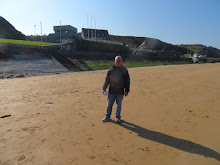
Come with me on my continuing tour of my Great Northwest trip when I went there on vacation last month. On Day 1, after flying into Portland, I saw the Mariners play in Seattle and went up in the Space Needle to enjoy the view of Puget Sound. On Day 2 I hiked around Mt. Rainier National Park. On Day 3 I drove into Idaho, the last state in the mainland that I hadn't visited.
On Day 4 I drove west through Washington for awhile, then crossed the Columbia River and drove towards Portland alongside that great river. Lewis and Clark traversed it in 1805 to finish off their trip to the Pacific when they explored the purview of the Louisiana Purchase for President Jefferson.
I drove around Mt. Hood, the largest mountain in Oregon. It's a currently dormant volcano that someday will undoubtedly blow its top with the same deadly effect that Mount St. Helens did in 1980 in Washington.
Then I hung a louie and went south a few hours. I wanted to see a spectacular sight the next day.
Wednesday, October 10, 2012
Tuesday, October 9, 2012
Idaho
The third day of my vacation to the Great Northwest, after seeing a Mariners game on day one and Mt. Rainier on the second day, I drove across Washington to Idaho. I had never been in Idaho before.
I stopped at a turnout on the border on a little highway from Washington into Idaho and exulted. As soon as I walked up to the sign saying "Idaho" I had traversed all 48 lower states (excluding Alaska and Hawaii).
Then I drove a few miles south on the main north/south highway in the Idaho panhandle to Lewiston, where I would pass back into Washington and possibly never return to Idaho, ever. But I found a funky old historic auto trail windy road off the main highway down the steep bluffs leading to Lewiston, an Idaho "deep water port" (up the Snake River, which feeds into the Columbia River, which is the largest river in North America which flows into the Pacific Ocean).
I drove down it at about 20 mph, winding round and round. Here's a picture I snapped showing all the switchbacks, with the town nestled in the valley below, along the river.
I stopped at a turnout on the border on a little highway from Washington into Idaho and exulted. As soon as I walked up to the sign saying "Idaho" I had traversed all 48 lower states (excluding Alaska and Hawaii).
Then I drove a few miles south on the main north/south highway in the Idaho panhandle to Lewiston, where I would pass back into Washington and possibly never return to Idaho, ever. But I found a funky old historic auto trail windy road off the main highway down the steep bluffs leading to Lewiston, an Idaho "deep water port" (up the Snake River, which feeds into the Columbia River, which is the largest river in North America which flows into the Pacific Ocean).
I drove down it at about 20 mph, winding round and round. Here's a picture I snapped showing all the switchbacks, with the town nestled in the valley below, along the river.
Monday, October 8, 2012
Mt. Rainier
I recently read a travel article where the columnist described the difference between how he and his wife approach planning a trip. He plans how to get there and then decides what to do when he arrives, whereas his wife meticulously plans each hour of every day.
The writer's approach is more my style, because when I went to the northwest for a week last month, after I had seen a baseball game in Seattle on the first day as planned, I didn't have no further plans other than driving into Idaho at some point because I'd never been in Idaho before, the only state in the lower 48 which I had never visited. I woke up the second morning and started planning my trip.
The paper revealed the recovery that week of the remains of four climbers lost the winter before on Mt. Rainier, apparently a very deadly mountain. So I went to see it.
It was spectacular all right. even though the road up to the base of it was closed for the season, since I wasn't a climber. Here's a picture of me at Mt. Rainier Park on the second day of my vacation.
The writer's approach is more my style, because when I went to the northwest for a week last month, after I had seen a baseball game in Seattle on the first day as planned, I didn't have no further plans other than driving into Idaho at some point because I'd never been in Idaho before, the only state in the lower 48 which I had never visited. I woke up the second morning and started planning my trip.
The paper revealed the recovery that week of the remains of four climbers lost the winter before on Mt. Rainier, apparently a very deadly mountain. So I went to see it.
It was spectacular all right. even though the road up to the base of it was closed for the season, since I wasn't a climber. Here's a picture of me at Mt. Rainier Park on the second day of my vacation.
Sunday, October 7, 2012
Back In Business
My Uncle died last year and he was the last WWII vet I personally knew. When I was a boy, every male adult that wasn't a grandfather was a WWII vet, practically every child I knew had a Dad who was a quiet hero.
I knew a tank killer in a tank destroyer in Patton's 3d Army, a Marine in the 1st Divison who knocked the Japanese back in the Pacific, a Bronze Star recipient who fought off Japanese kamikaze planes for a full day to both save his ship and earn his commendation, an officer who helped roust the Japanese from the Philippines, a pilot who bombed the Nazis in North Africa, a paratrooper who dropped in on Normandy on D-Day, etc.
But all of these heroes eventually died and I no longer personally knew a single WWII vet, once so common. Until yesterday.
On a trip this weekend to meet a childhood friend, I met his father-in-law, a Hellcat pilot on an escort Jeep Carrier in the Pacific. I so appreciated speaking with Ray about his service covering troop landings in the war against Japan and I am gratified that now I still know a WWII veteran.
I knew a tank killer in a tank destroyer in Patton's 3d Army, a Marine in the 1st Divison who knocked the Japanese back in the Pacific, a Bronze Star recipient who fought off Japanese kamikaze planes for a full day to both save his ship and earn his commendation, an officer who helped roust the Japanese from the Philippines, a pilot who bombed the Nazis in North Africa, a paratrooper who dropped in on Normandy on D-Day, etc.
But all of these heroes eventually died and I no longer personally knew a single WWII vet, once so common. Until yesterday.
On a trip this weekend to meet a childhood friend, I met his father-in-law, a Hellcat pilot on an escort Jeep Carrier in the Pacific. I so appreciated speaking with Ray about his service covering troop landings in the war against Japan and I am gratified that now I still know a WWII veteran.
Saturday, October 6, 2012
Made From Plants
Last month I spent a week in the northwest on my vacation, driving about 3,000 miles in a rental car through Oregon, Washington and Idaho, solely I had never been to any of those states. Unexpectedly, far from being monotonous or pure drudgery, the trip was a lot of fun because I had no idea how beautiful those places are.
More on that later. I saw a baseball game at Safeco Field in Seattle the first day, where the Oakland As beat the Mariners 4-2 in a game that featured five homers accounting for the six runs. Ironically, I read an article recently saying the Mariners were moving their outfield fences in next season, by up to twelve feet , to promote more home runs, I suppose.
That's a beautiful park. From the seats way up high behind home plate you can see both downtown and Puget Sound. It's not quite like being able to see Russia from there, I suppose, but it's still a wondrous sight, and nobody else hardly sits up there.
I bought a beer at the park and the container was so left coast. The cup was "Environmentally Friendly, Made From Plants, 100% Compostable." I so liked this cup I brought it home.
But I have been worrying that it will leak. Made from plants, what does that mean? Is it dishwasher safe?
So I decided to discard it. But I don't know how. It seems like plastic, so do I put it in the recycle bin?
Do I put it in the trash instead? Or do I throw it on the W&OD Bike Trail right of way behind my house as compost? There this hardy clear plastic cup with its brown, green and red piping and white and yellow lettering seems like it could sit and compost for years. What an environmental conundrum I have imported from the west coast.
More on that later. I saw a baseball game at Safeco Field in Seattle the first day, where the Oakland As beat the Mariners 4-2 in a game that featured five homers accounting for the six runs. Ironically, I read an article recently saying the Mariners were moving their outfield fences in next season, by up to twelve feet , to promote more home runs, I suppose.
That's a beautiful park. From the seats way up high behind home plate you can see both downtown and Puget Sound. It's not quite like being able to see Russia from there, I suppose, but it's still a wondrous sight, and nobody else hardly sits up there.
I bought a beer at the park and the container was so left coast. The cup was "Environmentally Friendly, Made From Plants, 100% Compostable." I so liked this cup I brought it home.
But I have been worrying that it will leak. Made from plants, what does that mean? Is it dishwasher safe?
So I decided to discard it. But I don't know how. It seems like plastic, so do I put it in the recycle bin?
Do I put it in the trash instead? Or do I throw it on the W&OD Bike Trail right of way behind my house as compost? There this hardy clear plastic cup with its brown, green and red piping and white and yellow lettering seems like it could sit and compost for years. What an environmental conundrum I have imported from the west coast.
Friday, October 5, 2012
Bucket Lists
I took my summer vacation last month. I went to the great northwest.
Why? Because at my age I keep lists.
As in, states I have never been in. That would be (as of early last month) Alaska, Hawaii, Idaho, Oregon and Washington,
Alaska and Hawaii are hard to get to, so they await another day. But I put a big check mark on all of the lower 48 last month.
Oh, I also keep track of the baseball stadiums I have visited and I saw a game at Safeco Field (Mariners) in Seattle. That's an out-of-the-way-place for an east coaster like me, but I got 'er done, so now my bucket list of current major league parks I have not seen a major league baseball game in has been reduced to two (new Yankee Stadium and new Florida Marlins Stadium).
Why? Because at my age I keep lists.
As in, states I have never been in. That would be (as of early last month) Alaska, Hawaii, Idaho, Oregon and Washington,
Alaska and Hawaii are hard to get to, so they await another day. But I put a big check mark on all of the lower 48 last month.
Oh, I also keep track of the baseball stadiums I have visited and I saw a game at Safeco Field (Mariners) in Seattle. That's an out-of-the-way-place for an east coaster like me, but I got 'er done, so now my bucket list of current major league parks I have not seen a major league baseball game in has been reduced to two (new Yankee Stadium and new Florida Marlins Stadium).
Monday, September 3, 2012
The hills of Staten Island
Growing up on Staten Island, my best friend Erik and I made the hills above our homes come alive with the sounds of battle. Some days we would don blue felt campaign hats and strap holsters containing cap-laden six guns around our waists and clamber up the steep slopes of the high rolling saddle back hills to the west called the Haystack, in search of Rebels as we re-fought the Civil War. Most days we would shoulder our Mattel tommy guns, fasten World War Two surplus canvas belts adorned with canteen holders and magazine pouches about our hips and go kill Germans from 5 to 8 pm on weeknights.
On weekends we would battle enemy forces all day long. Erik and I would traipse for miles through the hills and backwoods, laden with our toy implements of war. There was a series of undeveloped high ridges up there so we rarely encountered a street or a yard once we crossed the street I lived on, Trossach Road, and got onto the Haystack.
Usually we didn't see anyone or if we did,we skirted round them furtively. I remember how annoyed I was when a man walking about up there came across us unexpectedly before we saw him and avoided him and, spotting the modern aspect of our toy weaponry, he thought he was playing along with us by saying that he had spotted some "Russians" back a half-mile and we should "go check them out." This was even before the Vietnam war, and the nation's enemies were traditionally Germans or Japanese (or maybe Chinese in Korea), not Russians. World War Two was a mere 15 years past, Vietnam from here is a distant memory compared to that.
Erik was a swell best friend. As a boy, he had a lot of similar interests. If we weren't ensuring allied victory in the hills of Staten Island we were together literally wiping the floors in our respective bedrooms with Japanese or German soldiers. We each had a few hundred little green plastic Army men, bought at the drugstore for 99 cents a bagful. They were the enemy. We also each had a few dozen painted lead soldiers, bought at the dime store for 19 cents each. They were the Allied soldiers, These lead soldiers, now called pod foots for their distinctive feet which enable them to stand, are now collectibles but back then they were our all-powerful American army and they always wiped out those little green Army men.
We read comics together, built model airplanes, had sleepovers sometimes and even had an occasional youthful fistfight. But then I moved away and lost touch with Erik. I knew he got into the Air Force Academy but didn't like it so he transferred to Wagner College on Staten Island. After that there were four decades where . . . nothing.
Until a year and a half ago where through the magic of Facebook we re-connected. Through instant messaging in quick order I caught up with him and he with me. He is a successful administrator and he is also a pilot, fulfilling a life-long dream of his. He has a wonderful family with several bright and capable children. He came to DC a year ago and I had breakfast with him at his hotel, where I met his wonderful wife Jane, an accomplished woman in her own write. We all had a great conversation, and I could tell that Jane learned a tiny bit more about Erik's childhood by listening to our animated talk.
I haven't been good about keeping up with Erik since then. There's always time to rekindle a little bit later, right?
This morning I received a Facebook message from Erik, wishing me the best and wanting me to be aware of the news. It included a link to a news article. My heart sank. The code in the article's link included the identifying words "plane wreck."
Erik was seriously hurt when a plane he was aboard went down on August 19th on Long Island. Neither of the other two occupants of the plane, including Jane, survived. Erik is still in the hospital, suffering through painful burn surgery, gradually getting better, as I glean from the memorial website set up by his and Jane's children. The bandages finally same off his fingers last night, allowing him use of a keyboard, hence the message to me and, undoubtedly, many other unknowing but not uncaring friends.
I am so sorry Erik's loss. I can't imagine how he feels but his lost ones are in my thoughts and prayers. I am so glad that Erik gave me the opportunity of meeting Jane, I could tell from our brief encounter that she was a special person and that the two of them were very much in love. Get better, Erik.
The hills of Staten Island, those wooded ridges ranging westward from Trossach Road all the way to Wagner College, which a long time ago rang with the youthful shouts of boyish triumphs, sit still and silent now.
On weekends we would battle enemy forces all day long. Erik and I would traipse for miles through the hills and backwoods, laden with our toy implements of war. There was a series of undeveloped high ridges up there so we rarely encountered a street or a yard once we crossed the street I lived on, Trossach Road, and got onto the Haystack.
Usually we didn't see anyone or if we did,we skirted round them furtively. I remember how annoyed I was when a man walking about up there came across us unexpectedly before we saw him and avoided him and, spotting the modern aspect of our toy weaponry, he thought he was playing along with us by saying that he had spotted some "Russians" back a half-mile and we should "go check them out." This was even before the Vietnam war, and the nation's enemies were traditionally Germans or Japanese (or maybe Chinese in Korea), not Russians. World War Two was a mere 15 years past, Vietnam from here is a distant memory compared to that.
Erik was a swell best friend. As a boy, he had a lot of similar interests. If we weren't ensuring allied victory in the hills of Staten Island we were together literally wiping the floors in our respective bedrooms with Japanese or German soldiers. We each had a few hundred little green plastic Army men, bought at the drugstore for 99 cents a bagful. They were the enemy. We also each had a few dozen painted lead soldiers, bought at the dime store for 19 cents each. They were the Allied soldiers, These lead soldiers, now called pod foots for their distinctive feet which enable them to stand, are now collectibles but back then they were our all-powerful American army and they always wiped out those little green Army men.
We read comics together, built model airplanes, had sleepovers sometimes and even had an occasional youthful fistfight. But then I moved away and lost touch with Erik. I knew he got into the Air Force Academy but didn't like it so he transferred to Wagner College on Staten Island. After that there were four decades where . . . nothing.
Until a year and a half ago where through the magic of Facebook we re-connected. Through instant messaging in quick order I caught up with him and he with me. He is a successful administrator and he is also a pilot, fulfilling a life-long dream of his. He has a wonderful family with several bright and capable children. He came to DC a year ago and I had breakfast with him at his hotel, where I met his wonderful wife Jane, an accomplished woman in her own write. We all had a great conversation, and I could tell that Jane learned a tiny bit more about Erik's childhood by listening to our animated talk.
I haven't been good about keeping up with Erik since then. There's always time to rekindle a little bit later, right?
This morning I received a Facebook message from Erik, wishing me the best and wanting me to be aware of the news. It included a link to a news article. My heart sank. The code in the article's link included the identifying words "plane wreck."
Erik was seriously hurt when a plane he was aboard went down on August 19th on Long Island. Neither of the other two occupants of the plane, including Jane, survived. Erik is still in the hospital, suffering through painful burn surgery, gradually getting better, as I glean from the memorial website set up by his and Jane's children. The bandages finally same off his fingers last night, allowing him use of a keyboard, hence the message to me and, undoubtedly, many other unknowing but not uncaring friends.
I am so sorry Erik's loss. I can't imagine how he feels but his lost ones are in my thoughts and prayers. I am so glad that Erik gave me the opportunity of meeting Jane, I could tell from our brief encounter that she was a special person and that the two of them were very much in love. Get better, Erik.
The hills of Staten Island, those wooded ridges ranging westward from Trossach Road all the way to Wagner College, which a long time ago rang with the youthful shouts of boyish triumphs, sit still and silent now.
Subscribe to:
Posts (Atom)