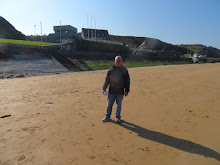
Easter Sunday falls on April 1st this year. I remember another year when it also fell on April 1st, and am keenly aware of yet another year when it did so.
The last time I remember Easter Sunday being on the first day of April, I was a senior in boarding school, run down from my scholastic workload and speaking on the phone with my Dad. I was feeling sorry for myself, going on and on about the several rejections I had received from colleges I'd applied to, and I bitterly noted that it was Easter Sunday, supposedly a time for hopeful change but here I was in the throes of rejection and feeling hopeless after four hard years away at this school.
My Dad was trying to be encouraging, saying that it was Harvard's, Antioch's and Colorado College's loss and the University of Colorado was a fine school, and since I had noted the date, perhaps I should reflect that Easter was traditionally a time of renewal and rebirth. "Yeah," I said cynically, "what a joke, April 1st, Easter Sunday, so full of hope and don't you know it's also April Fools Day."
My Dad said quietly to his complaining 17-year old son, "The last Easter Sunday I spent that was also April Fools Day, as you note, was when I was put ashore on Okinawa in 1945 with the rest of the First Marine Division." It was a teaching moment, a reference to the opening day of one of the worst battles of World War II, which produced 50,000 American casualties and that he participated in at the tender age of 20, and I was never so embarrassed by the juxtaposition of such a stark contrast of things young men are faced with.
Showing posts with label Okinawa. Show all posts
Showing posts with label Okinawa. Show all posts
Sunday, April 1, 2018


Saturday, June 8, 2013
What did you do in the war?
The man next to me on the gurney was old. But then so am I.
Old enough to be invisible. I have become reconciled to it.
We were both invisible. The phlebotomist got both of our blood drips going and then left us to go talk to the nurse across the room.
"Hey, how are you doing over there," I called out. The man's head snapped around and he said, "Fine. Happy birthday. I heard the nurses say it was your birthday when you came in."
"Yeah," I said, "what better way to celebrate your birthday than to donate your 99th unit of blood?" I was feeling frisky about my penultimate blood donation before I reached my lifetime goal of a century mark of blood donations and was bragging.
"This is my 188th donation," came the reply. My head snapped around and I looked at him and asked, "How old are you, sir?"
"Eighty-nine." I immediately launched into my ever-present quest to speak with every member of the greatest generation that I possibly can and asked, "So did you serve in World War II?'
"Yes," came the answer, "I was in the Navy in the Pacific."
"My dad was in the 1st Marine Division at Peleliu and Okinawa," I responded.
I looked across the room as we both bled out at the blood technician rapt in conversation with the nurse as us two old fogeys entertained ourselves. " I was off Okinawa," the man beside me said, "Those Kamikazes were terrible."
"My dad never faced a kamikaze, he merely flushed out dogged Japanese infantrymen from deep inside caves on the ridges." The old-timer wasn't biting on my talk about my dad.
"My ship was the Constellation, but then they changed its name to the USS Hope. We went to pick up the Bataan Death March survivors after the Japanese surrendered."
This was interesting. "They must have been in rough shape after being POWs for over three years."
"Yes they were. They were mere toothpicks when they came on board. They ate everything we put in front of them. We were making ice cream for them and they didn't even wait for it to freeze, they drank it in liquid form. Within the hour they were pregnant toothpicks."
I could imagine emaciated hollow-eyed men, mere skin and bones, forming grotesquely distended stomachs from rich feasting after years of starvation as their bellies blew up. "A doctor came down to the mess and put a stop to us feeding them. He said we would kill them if we fed them too much too fast, it would overwhelm their systems."

The octogenarian's name was Tony, he was a hero in World War II and he's still a hero. How many lives do you think he's saved with 188 blood donations? He was a spry fellow, he could get around just fine, and there was nothing wrong with his mind or his memory. I have learned that all you have to do is begin a conversation with someone considerably older than yourself and sometimes it can become a rich learning experience.
Old enough to be invisible. I have become reconciled to it.
We were both invisible. The phlebotomist got both of our blood drips going and then left us to go talk to the nurse across the room.
"Hey, how are you doing over there," I called out. The man's head snapped around and he said, "Fine. Happy birthday. I heard the nurses say it was your birthday when you came in."
"Yeah," I said, "what better way to celebrate your birthday than to donate your 99th unit of blood?" I was feeling frisky about my penultimate blood donation before I reached my lifetime goal of a century mark of blood donations and was bragging.
"This is my 188th donation," came the reply. My head snapped around and I looked at him and asked, "How old are you, sir?"
"Eighty-nine." I immediately launched into my ever-present quest to speak with every member of the greatest generation that I possibly can and asked, "So did you serve in World War II?'
"Yes," came the answer, "I was in the Navy in the Pacific."
"My dad was in the 1st Marine Division at Peleliu and Okinawa," I responded.
I looked across the room as we both bled out at the blood technician rapt in conversation with the nurse as us two old fogeys entertained ourselves. " I was off Okinawa," the man beside me said, "Those Kamikazes were terrible."
"My dad never faced a kamikaze, he merely flushed out dogged Japanese infantrymen from deep inside caves on the ridges." The old-timer wasn't biting on my talk about my dad.
"My ship was the Constellation, but then they changed its name to the USS Hope. We went to pick up the Bataan Death March survivors after the Japanese surrendered."
This was interesting. "They must have been in rough shape after being POWs for over three years."
"Yes they were. They were mere toothpicks when they came on board. They ate everything we put in front of them. We were making ice cream for them and they didn't even wait for it to freeze, they drank it in liquid form. Within the hour they were pregnant toothpicks."
I could imagine emaciated hollow-eyed men, mere skin and bones, forming grotesquely distended stomachs from rich feasting after years of starvation as their bellies blew up. "A doctor came down to the mess and put a stop to us feeding them. He said we would kill them if we fed them too much too fast, it would overwhelm their systems."

The octogenarian's name was Tony, he was a hero in World War II and he's still a hero. How many lives do you think he's saved with 188 blood donations? He was a spry fellow, he could get around just fine, and there was nothing wrong with his mind or his memory. I have learned that all you have to do is begin a conversation with someone considerably older than yourself and sometimes it can become a rich learning experience.
Sunday, May 26, 2013
Boom.
Tomorrow is Memorial Day. I want to tell you about a 20 year old U.S. Marine who was fighting for his country in April 1945 on Okinawa, a long slender island a few hundred miles south of Japan that was being seized by an American armada as a staging point for the expected invasion of Japan to end WWII.
The Marine was a radioman and he was atop a ridge line in the pelting rain of an electrical storm, transmitting coordinates to offshore ships for their fire control. Suddenly there was a tremendous noise and he was stunned and momentarily lost the ability to move.
"I remember looking down and seeing sparks arcing between the radio and my fingertips," he said decades later. Lightning had struck his radio's fully extended antenna.
When his senses returned he checked himself out, determined that he was uninjured, got up and ambled about for a few minutes until his stupor wore off and then went back to work transmitting coordinates in the thunderstorm. That was one of the few stories that Marine ever told about the grim Pacific War.
The Marine was my Dad, who passed away in 1986 when I was in my early thirties. I still miss him terribly.
The Marine was a radioman and he was atop a ridge line in the pelting rain of an electrical storm, transmitting coordinates to offshore ships for their fire control. Suddenly there was a tremendous noise and he was stunned and momentarily lost the ability to move.
"I remember looking down and seeing sparks arcing between the radio and my fingertips," he said decades later. Lightning had struck his radio's fully extended antenna.
When his senses returned he checked himself out, determined that he was uninjured, got up and ambled about for a few minutes until his stupor wore off and then went back to work transmitting coordinates in the thunderstorm. That was one of the few stories that Marine ever told about the grim Pacific War.
The Marine was my Dad, who passed away in 1986 when I was in my early thirties. I still miss him terribly.
Saturday, January 26, 2008
Happy Birthday, Dad
My father was born on this day during the roaring twenties. I was present when he died in 1986 after a courageous battle with lung cancer. I remember my mother standing over him weeping quietly, my brother sitting next to him with a long, set face, and my father obviously choosing that exact moment to leave us because it was time.
He was the most influential person in my life. Father, husband, lawyer, scholar, soldier, leader, doer, ethical man.
He just got things done with no fanfare. In WW2 he was a radioman in the Marines. At the battle of Okinawa he was atop a ridgeline during a torrential downpour when his aerial was struck by lightning.
This was one of the few war stories he ever told, none of which involved "combat." It came up in relation to another family member's description of a close encounter with lightning.
He said he was alone on a hilltop transmitting in the rain when suddenly there was a brilliant flash and a terrific sound. He was dazed and looked down to see sparks shooting from his fingertips. Then it got quiet and he realized that a lightning bolt had struck his extended antenna.
That was all he said about it but I asked him what he did next. I had vision s of the forties equivalent of dialing 911 to get medical attention there fast, at least to look him over.
He said, "Oh, I got up, ambled around for a minute, decided I was okay and so I went back to transmitting."
Those were the days. That's the type of man he was. That's how he spoke. He was a hero to me.
He was the most influential person in my life. Father, husband, lawyer, scholar, soldier, leader, doer, ethical man.
He just got things done with no fanfare. In WW2 he was a radioman in the Marines. At the battle of Okinawa he was atop a ridgeline during a torrential downpour when his aerial was struck by lightning.
This was one of the few war stories he ever told, none of which involved "combat." It came up in relation to another family member's description of a close encounter with lightning.
He said he was alone on a hilltop transmitting in the rain when suddenly there was a brilliant flash and a terrific sound. He was dazed and looked down to see sparks shooting from his fingertips. Then it got quiet and he realized that a lightning bolt had struck his extended antenna.
That was all he said about it but I asked him what he did next. I had vision
 s of the forties equivalent of dialing 911 to get medical attention there fast, at least to look him over.
He said, "Oh, I got up, ambled around for a minute, decided I was okay and so I went back to transmitting."
Those were the days. That's the type of man he was. That's how he spoke. He was a hero to me.
Subscribe to:
Comments (Atom)